new

Get trending papers in your email inbox!

Subscribe

Trending Papers

byAK and the research community

Trending Papers
Submitted by
Linzhan

UniMate: One Unified Model to Animate Diverse Skeletons

UniMate is a unified diffusion transformer that generates articulated motion for arbitrary skeletons from text and rigged 3D assets without per-skeleton retraining, using topology-aware attention and a large curated motion dataset.

princetonu Princeton University · Sep 4, 2026
Submitted by
LivXue

Raven: The Harness of Harnesses for Composable Agentic Intelligence

As large language models advance, AI agents are moving beyond isolated, domain-specific tasks toward long-horizon, cross-domain workflows. This transition exposes two challenges: increasing harness complexity makes manual design difficult to scale, while tighter coupling to specific domains limits the generality of a single harness. The central question thus shifts from how to engineer a stronger harness for one domain to how to autonomously construct specialized harnesses, improve them through experience, and orchestrate them across domains. We introduce Raven, The Harness of Harnesses, an open-source multi-agent ecosystem that automatically constructs and evolves modular harnesses for specific models and domains, treating each executable model--harness pair as a composable unit of intelligence. To support an All-Domain Collaboration Network, its Host Agent decomposes goals, matches subtasks to specialized agents, coordinates execution dependencies, and integrates results, while a host archive and EverOS preserve experience across tasks and Skill Forge makes that experience available as reusable procedures. Our theory establishes sufficient conditions for such composition to expand reliable task coverage beyond that of the available individual agents under a shared resource budget. On complex and long-horizon tasks, Raven significantly outperforms the state-of-the-art agent systems, pushing the frontier of composable agentic intelligence.

EverMindAI EverMind · Sep 27, 2026
Submitted by
rulins

Context Language Models

We introduce Context Language Models (CLMs), language models that natively manage their own context. We implement this by treating the context as a file and allowing the model to make unrestricted updates to this file. This allows the model to learn what is most important to maintain in context, and naturally extends to multi-agent systems where multiple agent contexts coexist as files. Building CLMs zero-shot with existing models outperforms SOTA context management strategies across a variety of tasks: 11.4% higher accuracy with 21.5% fewer FLOPs on BrowseComp-Plus, 5% higher scores with 59% fewer FLOPs on 12-hour EdgeBench, and 65% greater improvement with the same compute on a 24-hour multi-repository agent-swarm task. Moreover, by shifting context management from external harness control to intrinsic model behavior, CLMs naturally enable both in-context and parametric learning of context-management strategies. We show that CLMs can be steered with natural-language instructions evolved through a standard skill-optimization loop, improving held-out accuracy by up to 35.9 points on a context-management task while reducing compute. We also introduce an online reinforcement learning method for CLMs, improving Qwen3.5-9B performance on BrowseComp-Plus by 47.6% while using 12% fewer FLOPs. Finally, we co-design Suffix Cache Reuse for CLM serving, further reducing server-side compute by 35% relative to standard SGLang at matched performance.

meta Meta · Sep 29, 2026

TradingAgents: Multi-Agents LLM Financial Trading Framework

A multi-agent framework using large language models for stock trading simulates real-world trading firms, improving performance metrics like cumulative returns and Sharpe ratio.

  • 4 authors
· Dec 28, 2024
Submitted by
richardxp888

RRSI: Regularized Recursive Self-Improvement of Agent Harnesses

An LLM agent's capability is largely magnified by its harness, namely the prompts, control flow, tooling, memory, and context management surrounding the frozen backbone model. Recent methods increasingly automate this process by iteratively proposing and selecting component-wise edits of an agent harness, practically establishing a form of recursive self-improvement (RSI) at the agent-system level. However, such recursive evolution may overfit by memorizing the training tasks, showing large in-distribution gains that shrink or even vanish on out-of-distribution benchmarks. We introduce Regularized Recursive Self-Improvement of Agent Harnesses (RRSI), which incorporates the principles of regularizations into harness self-improvement by constraining the evolution candidate proposal and selection. The proposer operates with a temporally annealed budget, limiting how many edits a candidate can bundle, and it encourages unexplored trajectories based on evolution history. The selector is equipped with a critic and a pruner: the critic screens benchmark-specific proposals, while the pruner, removes changes that are too small, too expensive, or no longer useful. Together these constraints favor reusable agent mechanisms over benchmark-specific ones or even noises. Across eight benchmarks spanning coding, agentic workspace and engineering design tasks, RRSI gains up to 14.1 points on the split it evolves against and up to 4.7 points on the five out-of-distribution benchmarks, while producing a harness that runs on 30% fewer policy tokens than the unregularized evolution. Code is available at https://github.com/google-research/rrsi and project page is https://regularized-rsi.com/.

google Google · Sep 21, 2026
Submitted by
akhaliq

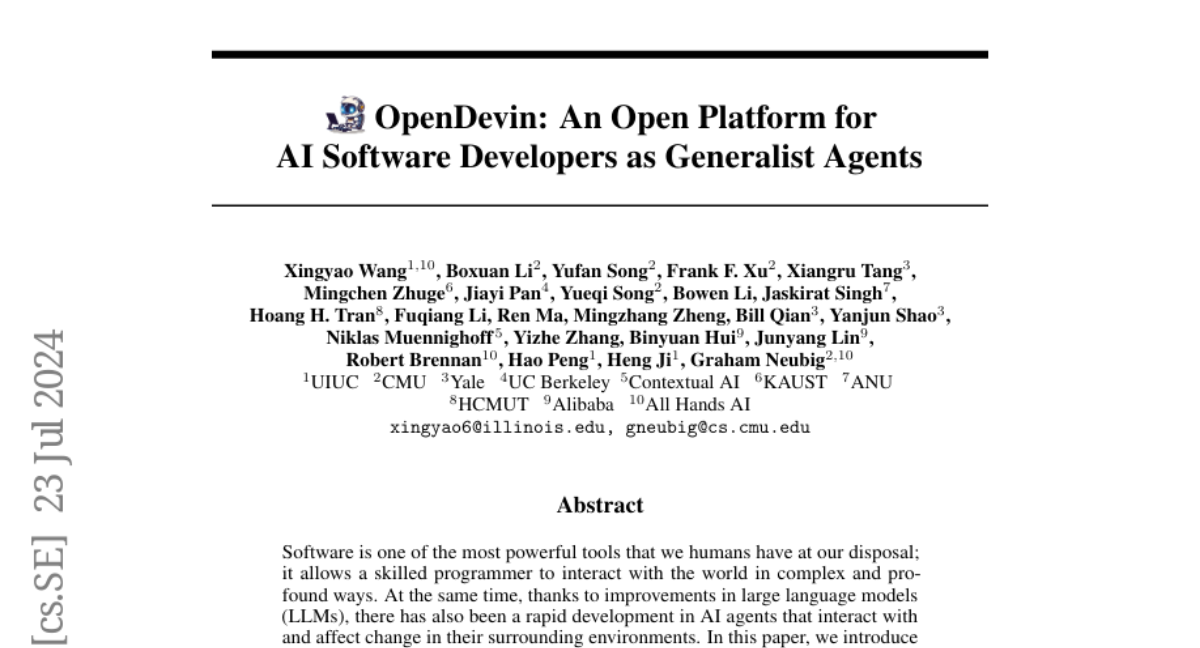
OpenDevin: An Open Platform for AI Software Developers as Generalist Agents

OpenDevin is a platform for developing AI agents that interact with the world by writing code, using command lines, and browsing the web, with support for multiple agents and evaluation benchmarks.

  • 24 authors
· Jul 23, 2024
Submitted by
PSRben

VisionHOPE: Visual Backbones as Self-Modifying Learning Systems

Visual backbones have evolved from Convolutional Neural Networks (CNNs) with local aggregation to Vision Transformers (ViTs) with global interactions, State-Space Models (SSMs) with input-dependent state transitions, and Test-Time Training (TTT) layers that adapt an inner learner while processing an image. Across this progression, visual computation has become increasingly adaptive to each input, yet the rules governing that adaptation remain largely prescribed by the trained backbone. We introduce VisionHOPE, the first generic visual backbone formulated as a self-modifying learning system, in which what the model remembers and how it learns co-evolve within an image. Building on the self-referential construction of Nested Learning (NL), VisionHOPE realizes this co-evolution through five coupled memories that store content, generate key and value representations, and govern learning rate and retention. These memories evolve jointly as visual context accumulates along each scan. However, directly applying the unconstrained self-referential update to a visual backbone leads to instability. We therefore derive a stability-matched step-size control scheme that combines a soft cap on self-referential injection with a spectral clamp on the retained memory transition, and prove that the resulting memory dynamics are non-expansive along each scan. For two-dimensional feature maps, we adapt NL's chunk formulation by aligning chunks with image rows and columns across four directional scans. The proposed VisionHOPE achieves competitive results on ImageNet-1K, COCO, and ADE20K, establishing self-modifying learning systems as a practical foundation for general-purpose visual backbones. The code is available at https://github.com/PSRben/VisionHOPE.

Mininglamp-2718 Mininglamp Technology · Sep 27, 2026
Submitted by
rhfeiyang

Hierarchical Continuous Diffusion Language Models

Discrete diffusion language models offer a compelling alternative to autoregressive generation for tasks demanding bidirectional reasoning and global constraint satisfaction. Yet they share a structural bottleneck: when decoding in parallel, each token is sampled independently from its marginal, severing the statistical dependencies among the tokens decoded together. Continuous diffusion language models avoid this by denoising a shared continuous state, but their denoiser sees only that state, so nothing ties it to a valid token configuration until it is finally decoded. To address this, we propose Hierarchical Continuous Diffusion Language Models (HC-DLM), which couple discrete token generation with a continuous latent trajectory in a single, principled denoising process, whose training objective is derived from a variational bound on the token likelihood. In contrast to recent methods that attach continuous context to a self-contained discrete chain, HC-DLM makes the latent the only persistent generative state: tokens are read out from it at every step and feed back as a scaffold for the next latent update. On structured reasoning (Sudoku), mathematical planning (Countdown) and language modeling (LM1B), HC-DLM improves over discrete and continuous diffusion baselines at matched model size, in puzzle accuracy on Sudoku and Countdown and in generative perplexity on LM1B. Project page: https://hc-dlm.github.io/.

Submitted by
akhaliq

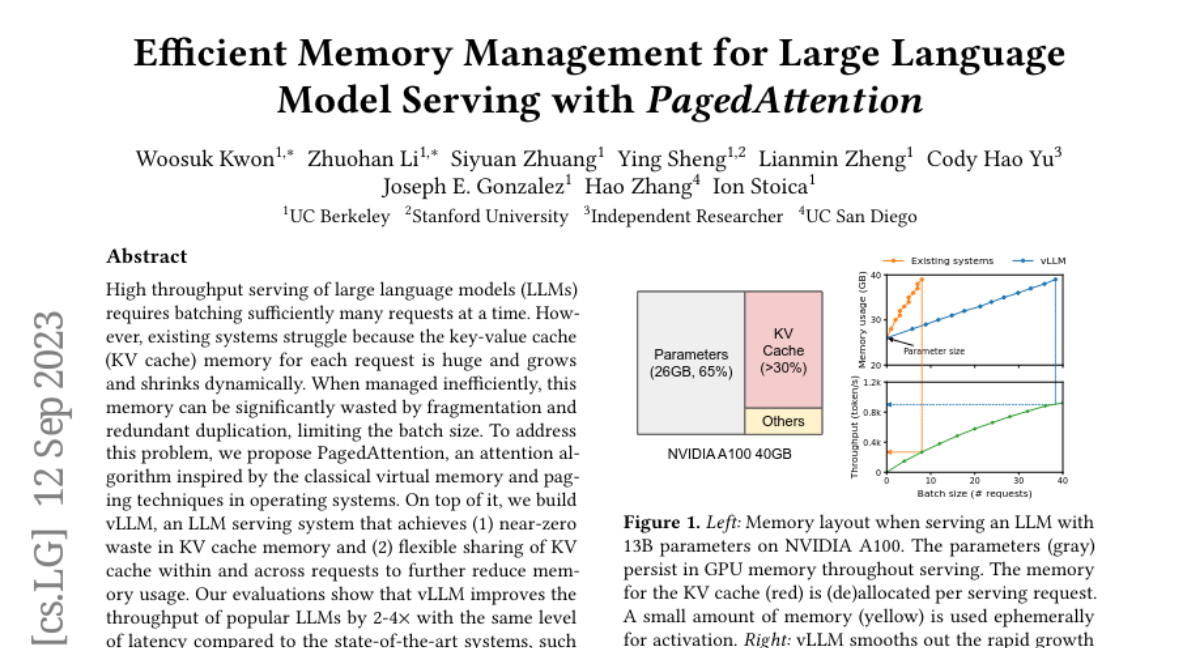
Efficient Memory Management for Large Language Model Serving with PagedAttention

PagedAttention algorithm and vLLM system enhance the throughput of large language models by efficiently managing memory and reducing waste in the key-value cache.

  • 9 authors
· Sep 12, 2023
Submitted by
talor-abr

SPEED-Bench: A Unified and Diverse Benchmark for Speculative Decoding

Speculative Decoding evaluation requires diverse workloads to accurately measure performance, which existing benchmarks lack, prompting the introduction of SPEED-Bench for standardized assessment across semantic domains and serving regimes.

nvidia NVIDIA · Feb 10, 2026
Submitted by
CongWei1230

PixelUMM: Encoder-Free Unified Image and Video Understanding and Generation

Unified Multimodal Models (UMMs) often rely on separate visual representations for understanding and generation, increasing visual context length and complicating integration with established vision-language pretraining pipelines. Recent advances in pixel-space modeling offer an encoder-free alternative, but extending this paradigm from images to videos is non-trivial: video understanding and generation adopt different temporal representations, leaving the design of a unified visual interface an open question. We present PixelUMM, an encoder-free model for unified image and video understanding and generation directly in pixel space. PixelUMM represents images as spatial patches and videos as spatiotemporal tubelets, connecting raw pixels to a shared multimodal backbone through single-layer linear projections. Its Mixture-of-Transformers architecture combines shared attention with task-specific parameters and extends clean-pixel prediction to video generation, jointly supporting autoregressive text prediction and pixel-space flow matching. Experiments show that PixelUMM achieves competitive performance across image and video understanding and generation tasks. We further conduct empirical studies of key design choices, including decoder design and spatial-temporal patch size, providing insights for future pixel-space unified multimodal models.

nvidia NVIDIA · Sep 29, 2026
Submitted by
oriuta

Apodex 1.1: Scaling Agentic Intelligence for Complex Work

Apodex 1.1 improves sustained, verifiable progress on complex real-world tasks by scaling executable environments and training agents to coordinate long-horizon work with state maintenance and recovery.

apodex Apodex · Aug 24, 2026
Submitted by
akhaliq

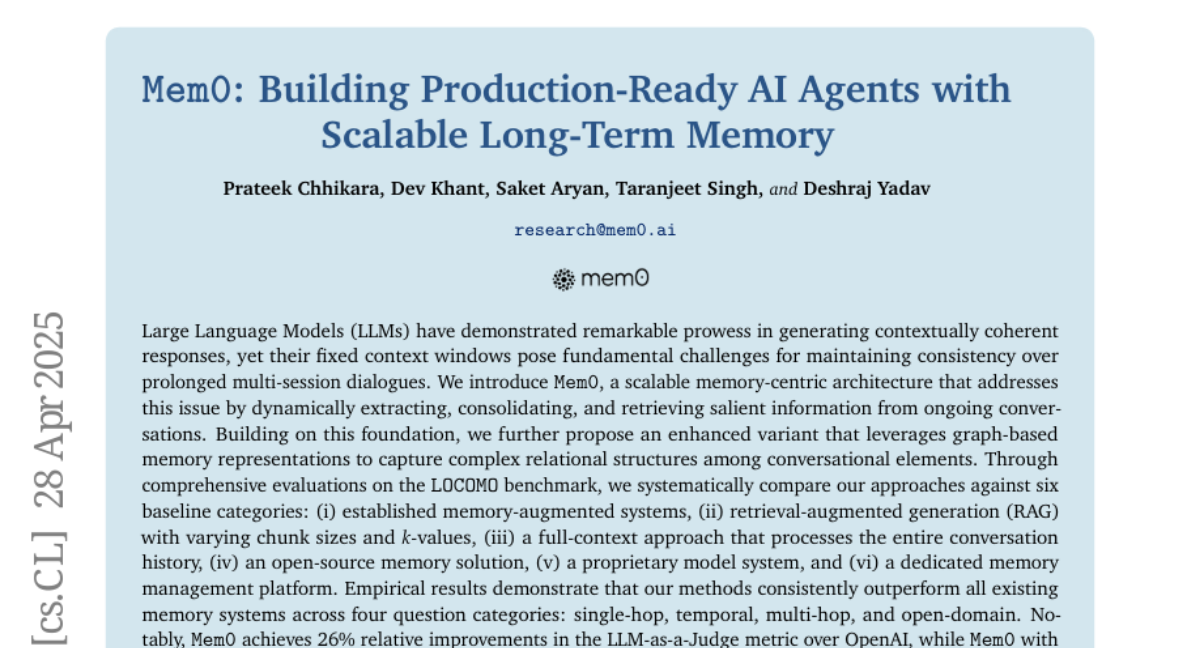
Mem0: Building Production-Ready AI Agents with Scalable Long-Term Memory

Mem0, a memory-centric architecture with graph-based memory, enhances long-term conversational coherence in LLMs by efficiently extracting, consolidating, and retrieving information, outperforming existing memory systems in terms of accuracy and computational efficiency.

  • 5 authors
· Apr 28, 2025
Submitted by
JarvisPei

NeoHorse-1: Towards Recursive Self-Improvement via Agentic Post-Training with Routing Harness

NeoHorse-1 uses agentic post-training with intelligent routing, structured feedback loops, and curriculum-based distillation to improve model capabilities across agent benchmarks.

TokenRhythm TokenRhythm · Sep 8, 2026
Submitted by
andito

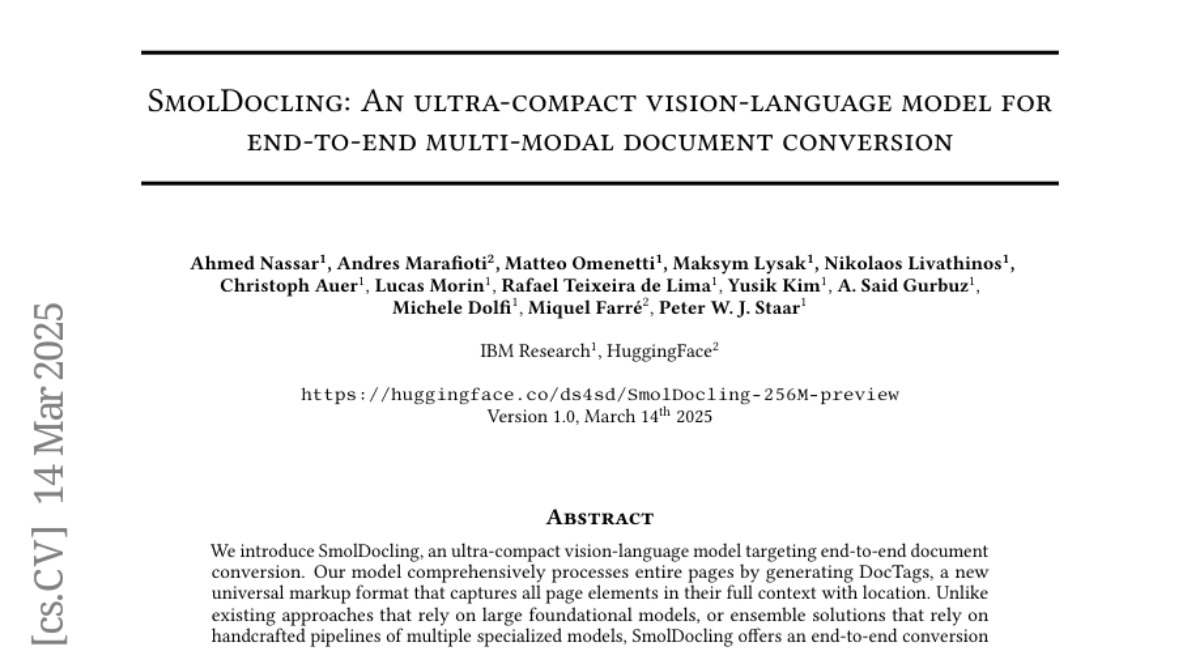
SmolDocling: An ultra-compact vision-language model for end-to-end multi-modal document conversion

SmolDocling is a compact vision-language model that performs end-to-end document conversion with robust performance across various document types using 256M parameters and a new markup format.

ibm-granite IBM Granite · Mar 14, 2025

Kronos: A Foundation Model for the Language of Financial Markets

Kronos, a specialized pre-training framework for financial K-line data, outperforms existing models in forecasting and synthetic data generation through a unique tokenizer and autoregressive pre-training on a large dataset.

  • 7 authors
· Aug 2, 2025
Submitted by
rpzhou

What Makes World Action Models Generalize? An Empirical Study of Test-Time Future Modeling

World action models (WAMs) predict the future alongside actions during training. Due to the heavy computation cost of video denoising, whether the future must still be generated during inference is disputed: Explicit WAMs denoise it into clean frames along with every action chunk, whereas Latent WAMs discard it entirely for acceleration. We find that latent WAMs, despite matching explicit ones on in-distribution tasks, fail to retain the generalization benefits that originally motivated WAMs. To demonstrate this, we evaluate generalization along three axes: environmental perturbation, data efficiency, and task generalization. Controlled comparisons with a matched backbone, training data, and budget reveal consistent degradation across all three axes when the action expert no longer conditions on future representations. Further analysis shows that the gap arises almost entirely from the first denoising step: the benefit comes from preparing the future, not generating it. We therefore propose Simple-WAM, which simplifies future modeling into a single forward pass of fully noised video tokens and adapts the training-time noise schedule to this inference behavior. Across simulation and real-world tasks, Simple-WAM achieves the best of both worlds, leading explicit WAMs in generalization performance with efficiency comparable to Latent WAMs. Project Page: https://zrporz.github.io/Simple-WAM-Web/

Tsinghua-LeapLab Tsinghua-LeapLab · Sep 29, 2026
Submitted by
WenyiWU0111

RSIGame: Autonomous Agentic Game Development with Recursive Self-improvement

Recent advances in large language models have made automatic game generation increasingly feasible, yet reliably improving generated games beyond a playable version remains challenging. Naive iterative refinement can easily overfit a small set of test cases, producing fragile games with unresolved bugs, missing behaviors, and poor generalization to broader player interactions. We introduce RSIGame, an autonomous agentic game development framework with recursive self-improvement. RSIGame organizes development into complementary local and global loops. Concretely, a local explore-diagnose-improve loop broadly explores the executable game, diagnoses and prioritizes discovered issues, and performs evidence-grounded revision, where an evolving checklist continually accumulates new testing and improvement guidance. A global loop tracks overall quality, preserves the best checkpoint, and detects saturation or regression over long-horizon development. Beyond test-time improvement, RSIGame further internalizes successful development experience into the generator through training. Across 140 GameCraft-Bench tasks, two game engines, and five generators, RSIGame consistently improves game quality under matched development budgets. Notably, experience internalization enables Qwen3.8-27B to reach 61.38 on Godot and 58.53 on Phaser, exceeding GPT-5.5 one-shot scores while reducing Qwen's generation tokens by 11 times.

RSIGame RSIGame · Sep 30, 2026
Submitted by
bupalinyu

The Other Half of the Memory Wall: Serving 35B MoEs from SSD with Trained Routing Prediction

Mixture-of-experts (MoE) inference on consumer hardware is bounded by weight memory: a 35B-class model is 19.5GB at 4-bit, and sparsity shrinks the compute per token, not the bytes that must be held. Naive offloading to SSD does not help on its own, because layer N+1's experts must be chosen before layer N's output exists, so the reads cannot start early enough to hide behind compute. We present Edge0, a streaming MoE inference engine that closes the gap with a prerouter: a per-layer head predicts the next layer's routing one token ahead, and the prediction is consumed as the routing itself, so the staged expert set equals the routed set and nothing is dropped. An unmerged recovery LoRA, trained on the student path, pays back the quality lost to int4 quantization and routing replacement. On a single 24GB machine, Edge0 serves a 35B MoE at 20tok/s inside 3GiB of peak active memory, within a few points of its fp16 teacher on average across five public benchmarks. An 8B tier runs on the same framework, and the framework, checkpoints, and adapters are open source.

Edge0 Edge0 · Sep 16, 2026
Submitted by
a43992899

YuE2: Unifying Symbolic and Audio Music Generation at Frontier Quality

Symbolic models make melody, harmony, rhythm, and form explicit but typically stop before a finished recording; audio models produce complete songs while leaving composition implicit. We introduce YuE2, which unifies symbolic and audio music generation at frontier quality through symbolic planning. A single AR-NAR Mixture-of-Transformers (MoT) first writes a readable score specifying melody and harmony, expands it into semantic music tokens, and realizes it as full-song audio. In comparisons using the same checkpoint, experts prefer symbolic planning for overall quality and musicality, with 49.3% of overall preferences versus 34.6% without planning. Experts also favor the unified model over a separate language model and diffusion Transformer. On WildSongBench, YuE2 scores 6.73 on SongBench Global Avg, exceeding all evaluated public baselines. Selecting from eight candidates (best-of-8), YuE2 reaches 6.96, the highest observed mean among all evaluated systems. Expert listening further establishes its competitiveness with proprietary song generators, favoring best-of-8 over Suno v4.5 and yielding nearly balanced preferences against Suno v5. To learn this generation process from recordings without aligned scores, we introduce MERT2 and SheetSage2 to supply semantic and symbolic supervision. MERT2 sets a new state of the art in music representation learning, surpassing previous best results on 14 of 15 MARBLE metrics; SheetSage2 leads 12 of 15 benchmark-metric pairs in our lead-sheet transcription comparison. The same checkpoint follows score edits while largely preserving unedited musical content and generates zero-shot covers without cover-specific training. Its readable score also enables agentic music editing, with external language models translating user feedback into revisions of the composition.

Submitted by
taesiri

SkillOpt: Executive Strategy for Self-Evolving Agent Skills

SkillOpt introduces a systematic text-space optimizer for agent skills that trains skills as external agent state with stable updates and zero deployment inference overhead, achieving superior performance across multiple benchmarks and execution environments.

MicrosoftResearch Microsoft Research · May 22, 2026
Submitted by
taesiri

MinerU2.5: A Decoupled Vision-Language Model for Efficient High-Resolution Document Parsing

MinerU2.5, a 1.2B-parameter document parsing vision-language model, achieves state-of-the-art recognition accuracy with computational efficiency through a coarse-to-fine parsing strategy.

  • 61 authors
· Sep 26, 2025
Submitted by
andy-yang

FreeToken: Efficient Edge-Native MoE Serving with Bandwidth-Adaptive Execution

FreeToken is an edge-native Mixture-of-Experts serving system that dynamically maps computation and model state onto heterogeneous local hardware to run large open-weight models on personal machines.

A decoder-only foundation model for time-series forecasting

A large language model adapted for time-series forecasting achieves near-optimal zero-shot performance on diverse datasets across different time scales and granularities.

  • 4 authors
· Oct 14, 2023
Submitted by
ChengCui

PaddleOCR-VL-1.6: Expanding the Frontier of Document Parsing with Under-Optimized Region Refinement and Progressive Post-Training

PaddleOCR-VL-1.6 enhances document parsing performance through targeted data optimization and progressive post-training techniques, achieving state-of-the-art results on OmniDocBench v1.6.

PaddlePaddle PaddlePaddle · Jun 2, 2026
Submitted by
akhaliq

Very Large-Scale Multi-Agent Simulation in AgentScope

Enhancements to the AgentScope platform improve scalability, efficiency, and ease of use for large-scale multi-agent simulations through distributed mechanisms, flexible environments, and user-friendly tools.

  • 8 authors
· Jul 25, 2024

PyTorch Distributed: Experiences on Accelerating Data Parallel Training

The PyTorch distributed data parallel module optimizes large-scale model training using techniques like gradient bucketing, computation-communication overlap, and selective synchronization to achieve near-linear scalability.

  • 11 authors
· Jun 28, 2020
Submitted by
taesiri

GameHorizon Suite: Multi-Horizon Data and Evaluation in Gameplay

Modern video games provide a measurable testbed for AI models, combining abilities of visual understanding, instruction decomposition, goal planning, and precise action control over multiple temporal horizons. Existing datasets and benchmarks, however, either cover a narrow range of games, lack language instructions, or rely on high-variance online rollouts. To address these challenges, we introduce GameHorizon, a unified data and evaluation suite that measures gameplay capabilities at different horizons for diverse model families. GameHorizon Suite consists of three components. First, GameHorizon-Annotator is a scalable and automated annotation pipeline for multi-horizon instructions. Second, utilizing the pipeline, we construct GameHorizon-Data, the first large-scale AAA gameplay dataset with temporally aligned videos, player actions, and multi-horizon instructions. It comprises 5,000 hours of recordings from 21 games, collected by 100 human expert players. Third, we build GameHorizon-Bench with reproducible offline and stepwise online testing. The offline track enables reproducible evaluation using thousands of standardized questions organized into three primary tasks and a series of diagnostic variants, while the online track tests whether offline scores reflect actual gameplay capabilities and localizes failures to specific steps within long-horizon gameplay. Based on our GameHorizon Suite, we evaluate 47 models through more than one million model invocations, revealing a meaningful hierarchy of task difficulty and pronounced differences in model capabilities. Our work can provide a standardized yardstick for evaluating gameplay capabilities across horizons and model families. We will release our dataset, annotator, and benchmark to facilitate future research.

tencent Tencent · Sep 21, 2026
Submitted by
taesiri

Unlimited OCR Works

Unlimited OCR introduces Reference Sliding Window Attention to eliminate growing memory consumption during long-sequence OCR tasks, enabling efficient transcription of multiple pages in a single forward pass.

baidu BAIDU · Jun 22, 2026
Submitted by
taesiri

AgentScope 1.0: A Developer-Centric Framework for Building Agentic Applications

AgentScope enhances agentic applications by providing flexible tool-based interactions, unified interfaces, and advanced infrastructure based on the ReAct paradigm, supporting efficient and safe development and deployment.

  • 23 authors
· Aug 22, 2025

HOI-Retarget: Contact-Centric Retargeting for Human-Object Interaction

Learning from demonstration (LfD) has enabled humanoid robots to acquire diverse whole-body skills, but extending this paradigm to human-object interaction (HOI) is limited by the availability of robot-compatible interaction references. We present HOI-Retarget, a contact-centric retargeting method that transfers HOI onto a humanoid robot for large-scale motion-data generation. Its windowed trajectory optimization uses every labeled contact as a target in the object frame, balancing body tracking, foot support and smoothness under the robot's kinematic limits. The method can augment a single demonstration across object sizes, absorb contacts reconstructed from monocular video, and extend to several robots manipulating one object. We publicly release the code and the retargeted motion dataset.

  • 5 authors
· Sep 28, 2026
Submitted by
taesiri

Lyra: Generative 3D Scene Reconstruction via Video Diffusion Model Self-Distillation

A self-distillation framework converts implicit 3D knowledge from video diffusion models into an explicit 3D Gaussian Splatting representation, enabling 3D scene generation from text or images.

  • 13 authors
· Sep 23, 2025

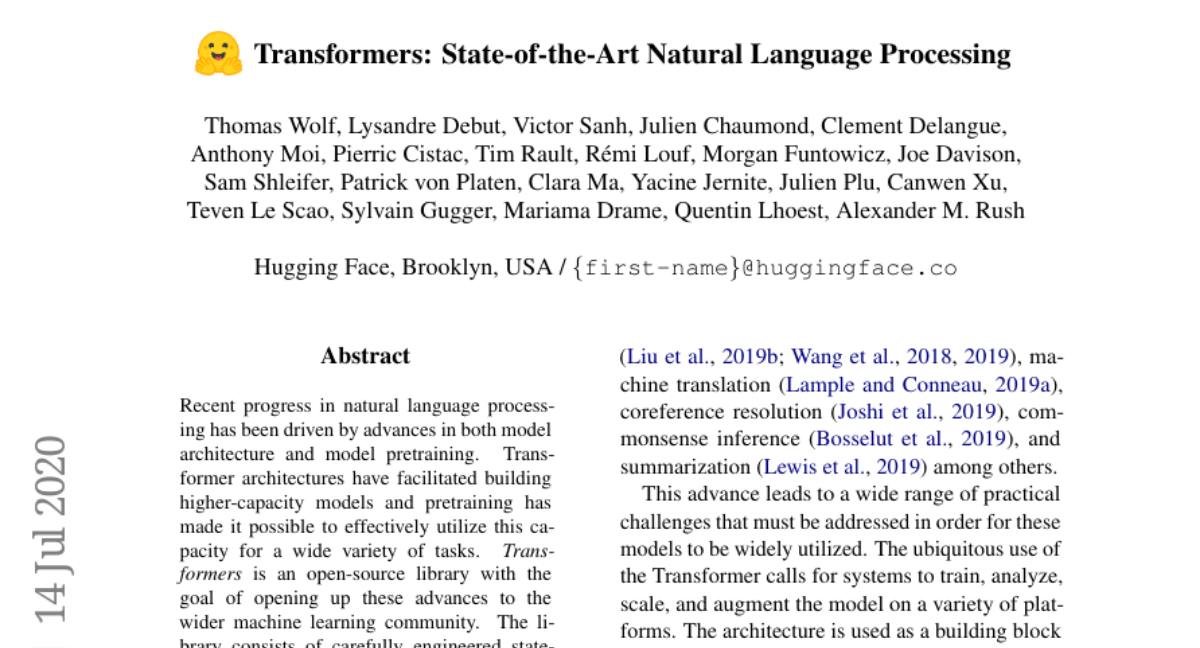
HuggingFace's Transformers: State-of-the-art Natural Language Processing

Transformers library provides state-of-the-art Transformer architectures and pretrained models for natural language processing tasks with a unified API and emphasis on extensibility and robust deployment.

huggingface Hugging Face · Oct 9, 2019
Submitted by
Hokin

Training Object Permanence in World Models

Object permanence and solidity are hallmarks of human cognitive priors. Recent studies show that video generation models, a paradigmatic class of current world models, have begun to show emerged reasoning abilities, making them ideal candidates for building human-like physical intelligence. Do video models have emerged object permanence in them? If not, could we train them with a core-cognition inspired dataset? We introduce WROP (World Reasoning with Object Permanence), a data infrastructure of 150 hand-designed cognitive science inspired tasks, divided into six cognitive categories. We build Blender generators that randomize speed, lighting, camera angle, and other nuisance parameters while preserving each task's cognitive structure, yielding 10,000+ samples per task. We release a 1.5M-sample training corpus and a 300-question exam. On this exam we evaluate 14 video models: 3 reference-to-video, 7 edit, and 4 continuation, among which PWM-WROP, our 16B world model. In a blind pairwise Elo study, PWM-WROP ranks first among continuation models and third overall, behind only a statistical tie between two reference-to-video models. We release the data, exam, model answers, scores, weights, and PWM, our native-PyTorch training stack on AWS Trainium2.

Submitted by
nielsr

RelateAnything: Real-Time Open-Vocabulary Relation Prediction From Any Inputs

RelateAnything is a lightweight open-vocabulary relation prediction model that accepts arbitrary predicate vocabularies and region sources at inference, trained on a large geometrically verified dataset with positive-unlabeled supervision and evaluated on a new cross-dataset benchmark.

  • 1 authors
· Sep 11, 2026

AutoDev: Automated AI-Driven Development

AutoDev is an AI-driven software development framework that automates complex engineering tasks within a secure Docker environment, achieving high performance in code and test generation.

  • 5 authors
· Mar 13, 2024
Submitted by
RuofengYang

ARIS: Autonomous Research via Adversarial Multi-Agent Collaboration

ARIS is an open-source research harness that uses cross-model adversarial collaboration to ensure reliable long-term research outcomes through coordinated execution, orchestration, and assurance layers.

Submitted by
taesiri

LongCat-Video Technical Report

LongCat-Video, a 13.6B parameter video generation model based on the Diffusion Transformer framework, excels in efficient and high-quality long video generation across multiple tasks using unified architecture, coarse-to-fine generation, and block sparse attention.

meituan-longcat LongCat · Oct 25, 2025
Submitted by
jasonrqh

COLLEAGUE.SKILL: Automated AI Skill Generation via Expert Knowledge Distillation

Person-grounded AI skills are automatically distilled from heterogeneous traces into inspectable, correctable packages that capture both capabilities and behavioral patterns.

ShanghaiAiLab shanghai ailab · May 29, 2026
Submitted by
akhaliq

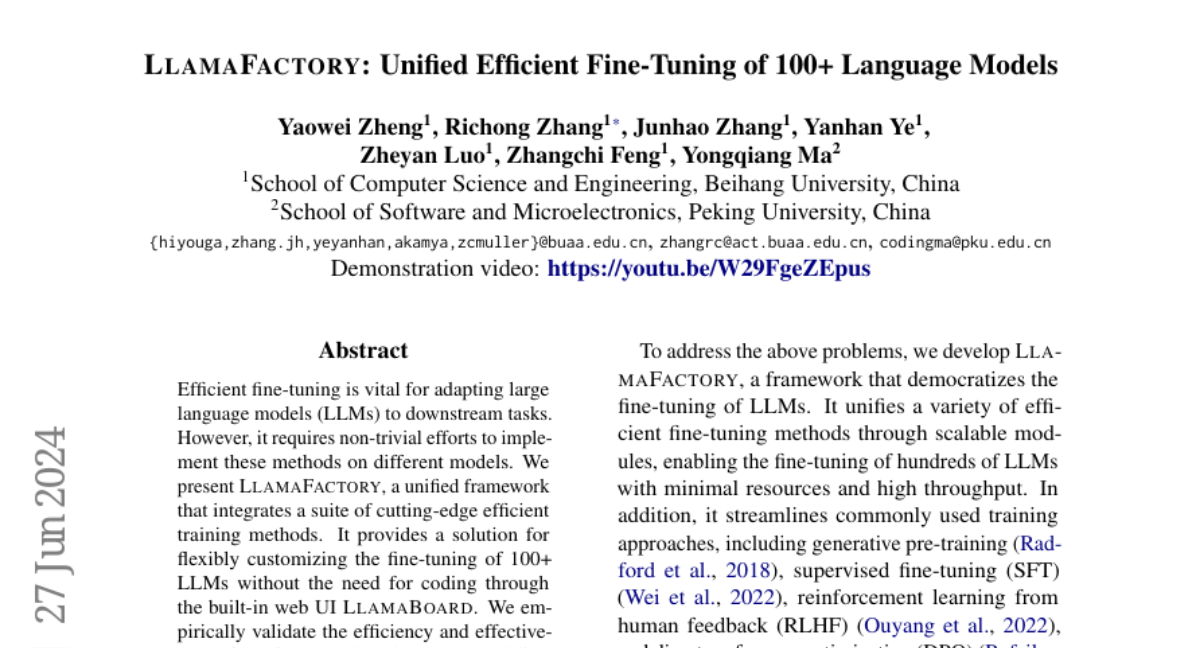
LlamaFactory: Unified Efficient Fine-Tuning of 100+ Language Models

LlamaFactory is a unified framework enabling efficient fine-tuning of large language models across various tasks using a web-based user interface.

  • 5 authors
· Mar 20, 2024
Submitted by
Sensen02

SoL-Pi: Recursively Scaling Auto-Research Loops for Efficient Agent Harness

As coding agents move from supervised code completion to unattended, around-the-clock exploration, their work expands from isolated predictions into long trajectories of reasoning, tool use, and feedback. Token efficiency therefore becomes important for scaling recursive self-improvement. We take an RSI-inspired approach at the harness layer, scaling auto-research loops across increasingly numerous and diverse environments for harness rollouts. At this scale, the process yields reusable improvements that transfer beyond their development setting, moving automated harness discovery toward production-level outcomes. Four mechanisms survive selection and form SoL-Pi, spanning action execution, context compaction, observation handling, and delegated reading. On the 51-task EdgeBench evaluation, SoL-Pi achieves performance comparable to Pi across GPT-5.6 Sol and Opus 5 while reducing recorded token traffic by 44.7-49.0% and API cost by about one third. In other words, estimated hourly savings are \8.75-13.50 relative to native Codex and Claude Code harnesses, and \4.36-5.71 relative to Pi.

nvidia NVIDIA · Sep 17, 2026

Zep: A Temporal Knowledge Graph Architecture for Agent Memory

Zep, a memory layer service, outperforms MemGPT in the DMR benchmark and LongMemEval by excelling in dynamic knowledge integration and temporal reasoning, critical for enterprise use cases.

  • 5 authors
· Jan 20, 2025

Harness VLA: Steering Frozen VLAs into Reliable Manipulation Primitives via Memory-Guided Agents

Language-conditioned manipulation requires both precise contact-rich control and robust reasoning over language, scenes, and long horizons. End-to-end Vision-Language-Action (VLA) models provide strong local visuomotor skills, but they are trained on in-distribution task trajectories and often fail under deployment perturbations such as semantic retargeting, goal re-binding, spatial-layout shifts, and unstable local contacts. LLM coding agents provide complementary semantic and compositional reasoning, but purely analytic primitives struggle with irregular grasping, constrained placement, and articulated-object interaction. We present Harness VLA, a memory-augmented agentic framework that exposes a frozen VLA as a retryable contact-rich primitive and composes it with a small fixed library of analytic primitives for grounding, staging, transport, navigation, and release. Rather than expanding the skill library, the harness learns the operating range of these fixed primitives from task-specific execution traces, global success rules, and failure models. By lifting semantic re-grounding, non-contact execution, and VLA re-staging to the planner while reserving the frozen VLA for local contact-rich phases, Harness VLA extends pretrained VLAs beyond their original trajectory distribution without finetuning. Across perturbed tabletop, household kitchen, and clean-to-randomized bimanual manipulation, Harness VLA improves over the strongest relevant baselines by 38.6 and 25.4 percentage points on LIBERO-Pro and RoboCasa365, respectively, and reaches 58.4% on RoboTwin C2R.


  • 16 authors
· Jul 9, 2026
Submitted by
milkkarten

Prime Agent: A Self-Improving RLM Harness

Prime Agent is an open-source harness that uses recursive subagents, persistent computation, and agent-to-agent coordination to extend language models' long-horizon capabilities across coding and reasoning tasks.

PrimeIntellect Prime Intellect · Aug 24, 2026
Submitted by
Michaelqaz

GAE: Learning a Geometry-Native Latent Space for 3D-Consistent World Generation

We present a compact geometry-native latent space as a shared foundation for perception and generation. Visual generators can produce photorealistic frames without preserving a consistent 3D scene. We argue that this is not only a modeling problem but also a representation problem: generators typically evolve appearance-centric latents, while perception models recover geometry in a semantically rich space that encodes cross-view structure. Rather than adding geometry as another output, we reparameterize a geometry foundation model's features into a compact latent space for generation. We realize this shift with the geometry-native autoencoder (GAE), whose latent is jointly decodable to appearance, depth, cameras, and point maps. With this state, a standard conditional flow supports diverse generation tasks. In controlled comparisons that hold the generator and training protocol fixed, replacing the latent with GAE improves both visual quality and independently measured 3D coherence: FVD falls by 12.7% and 23.1% on RealEstate10K and DL3DV, and camera-trajectory error is halved on RealEstate10K. Together, these results show that the latent space is central to geometry-consistent generation and can serve as a shared interface between perception and generation.

TencentARC ARC Lab, Tencent · Sep 21, 2026
Submitted by
Drexubery

WorldCrafter: Consistent Video World Model with Implicit 3D-aware Memory

Video world models enable interactive exploration of dynamic environments, yet struggle to respect prior observations over long horizons and across viewpoints. We present WorldCrafter, a video world model that learns a camera-queryable implicit 3D-aware memory for this purpose. The key insight is to let the requested viewpoint shape how multi-view evidence is compressed into the video generator's limited token budget. Trained jointly with the video generator, a memory encoder and pose-conditioned readout module integrate historical observations into a fixed set of target view-specific tokens before denoising, without explicit depth-based correspondences. By combining this memory with recent temporal context and few-step distillation, WorldCrafter enables streaming scene exploration from a single input image or text prompt. Experiments across static and dynamic scenes show substantial gains in long-horizon consistency and camera-control accuracy while preserving visual quality during minute-scale exploration.

TencentARC ARC Lab, Tencent · Sep 21, 2026
Submitted by
taesiri

Paper2Agent: Reimagining Research Papers As Interactive and Reliable AI Agents

Paper2Agent converts research papers into interactive AI agents to facilitate knowledge dissemination and enable complex scientific queries through natural language.

  • 4 authors
· Sep 8, 2025
Submitted by
aejion

WorldPlay2: Extending Real-Time Interactive World Models in Control and Horizon

Interactive world models require responding in real time to versatile controls and maintaining long-horizon consistency. However, modeling heterogeneous controls remains difficult, while explosive contexts and unstable distillation impede achieving both long-horizon consistency and real-time responsiveness. In this paper, we present WorldPlay2, an interactive world model that couples a factorized hybrid control interface with a co-design of compressed memory and stable distillation. 1) Our factorized hybrid control interface integrates frame-aligned action control with structured semantic control that explicitly disentangles scene appearance, character identity, and dynamic semantic events, thereby facilitating effective control learning. 2) To achieve efficient long-horizon modeling, we compress historical contexts into compact memory tokens shared by the autoregressive student and the bidirectional teacher. This design enables clip-wise, memory-conditioned score evaluation instead of jointly processing an entire long rollout, substantially reducing distillation overhead. 3) We further propose Stable Forcing, which initializes the autoregressive student via a few-step strategy and leverages full-rollout replay to preserve the quality of long-horizon rollouts, ensuring robust and stable distillation. Extensive experiments demonstrate the strong generalizability of our model and its superior performance compared to existing methods.

  • 8 authors
· Sep 28, 2026
Submitted by
zhangshaolei

EvoOntology: A Self-Evolving Ontology Layer for Data Agents

Data agents aim to fulfill natural-language instructions over heterogeneous data, including tables, files, and databases. However, data agents face a challenging agent-data gap: heterogeneous data resides outside the agent, while the agent can access it (e.g., column names and file paths) only through generic tools. Existing approaches either let agents directly explore raw data sources or inject manually constructed semantic layers into prompts. However, neither scales well to large heterogeneous data sources nor adapts to different agent behaviors. In this paper, we introduce EvoOntology, a self-evolving ontology layer for data agents. EvoOntology encapsulates the ontology as an MCP server comprising a schema layer, a content layer, and a tool layer, enabling agents to actively query and interact with the ontology at runtime. To this end, we introduce a builder agent for autonomous ontology construction and a self-evolution loop that continuously refines the ontology through attribution-guided typed edits that are accepted only after a backbone-conditional paired evaluation. Experiments on three well-adopted data-agent benchmarks with four LLM backbones demonstrate that EvoOntology consistently outperforms strong baselines and existing semantic-layer approaches, effectively bridging the agent-data gap and enabling more effective interaction with heterogeneous data. Code: https://github.com/ruc-datalab/EvoOntology

RUC-DataLab RUC-DataLab · Sep 14, 2026
Submitted by
nielsr

Ultralytics YOLO26: Unified Real-Time End-to-End Vision Models

YOLO26 addresses real-time vision challenges through a unified model family with NMS-free inference, improved training strategies, and multi-task capabilities spanning detection, segmentation, and pose estimation.

Ultralytics Ultralytics · Jun 2, 2026